
FNIRSI DSO152 Handheld Oscilloscope 200kHz Bandwidth, 2.5MS/s Sampling Rate
4.4Editor score
200kHz bandwidth with 2.5MS/s sampling
2.8 inch HD LCD display screen
Built-in 1000mAh battery life
Finding the right measurement tool is crucial for electronics work. A cheap oscilloscope can provide essential waveform analysis without breaking the bank. These devices allow you to visualize electrical signals and troubleshoot circuits effectively.
We evaluated ten top rated models based on specifications user feedback and real world performance. Our comparison considers bandwidth sampling rates screen quality and additional features like multimeter functions to help you choose wisely.
Each pick highlights specific strengths for different needs from portable field work to bench testing. Prices and availability change frequently so verify current details before purchasing to ensure you get the best value today.
4.4Editor score

4.3Editor score
4.3Editor score
As an Amazon Associate we earn from qualifying purchases.
This side by side comparison outlines the key specifications and capabilities of the ten selected models to help you quickly identify which device matches your specific testing requirements and budget constraints.


The FNIRSI DSO152 stands out as the top budget choice for hobbyists needing basic waveform visualization. With a 200kHz bandwidth and 2.5MS/s sampling rate it handles low frequency signals effectively. Its 4.4 rating reflects reliable performance for introductory electronics projects.
We may earn a commission when you buy through this link, at no additional cost to you.
Its compact design makes it ideal for field diagnostics where portability matters most. The 2.8 inch HD LCD provides clear visibility of waveforms while the one-key AUTO function simplifies setup for beginners. Battery life supports several hours of continuous use.
Trade-offs include limited bandwidth which restricts use to audio or power supply analysis rather than RF work. The interface lacks advanced math features but this keeps costs low. These limitations are acceptable given the extremely accessible price point.
Buy this if you need an entry level tool for learning electronics or repairing household appliances. It offers essential capabilities without financial risk making it perfect for students or DIY enthusiasts starting their oscilloscope journey today.
The lightweight pocket form factor allows you to carry the scope anywhere for immediate troubleshooting without heavy equipment.
Auto measurement features reduce setup time so you can focus on analyzing circuits instead of configuring parameters manually.
We may earn a commission when you buy through this link, at no additional cost to you.
The FNIRSI 2C53T earns our Editor's Choice for delivering exceptional versatility. It combines a 50MHz oscilloscope multimeter and signal generator into one unit. This integration reduces the need for multiple tools on your workbench while maintaining solid performance.
We may earn a commission when you buy through this link, at no additional cost to you.
Its 250MSa/s sampling rate and 50MHz bandwidth handle many digital and analog tasks effectively. The multimeter supports up to 19999 counts offering precision measurements. Users appreciate the ability to save and compare waveforms using the reference waveform feature.
Some users note screen brightness requires adjustment for optimal grid clarity. Multimeter measurements are good but not lab grade. These are minor drawbacks given the extensive feature set provided for the price.
Choose this model if you need a comprehensive toolkit for varied projects without investing in separate devices. It suits hobbyists who want advanced features like spectrum analysis without professional costs.
Carrying one device instead of three saves space and time during repairs or prototyping sessions.
Persistence mode and XY plots help visualize complex signal behaviors that standard scopes miss.
We may earn a commission when you buy through this link, at no additional cost to you.
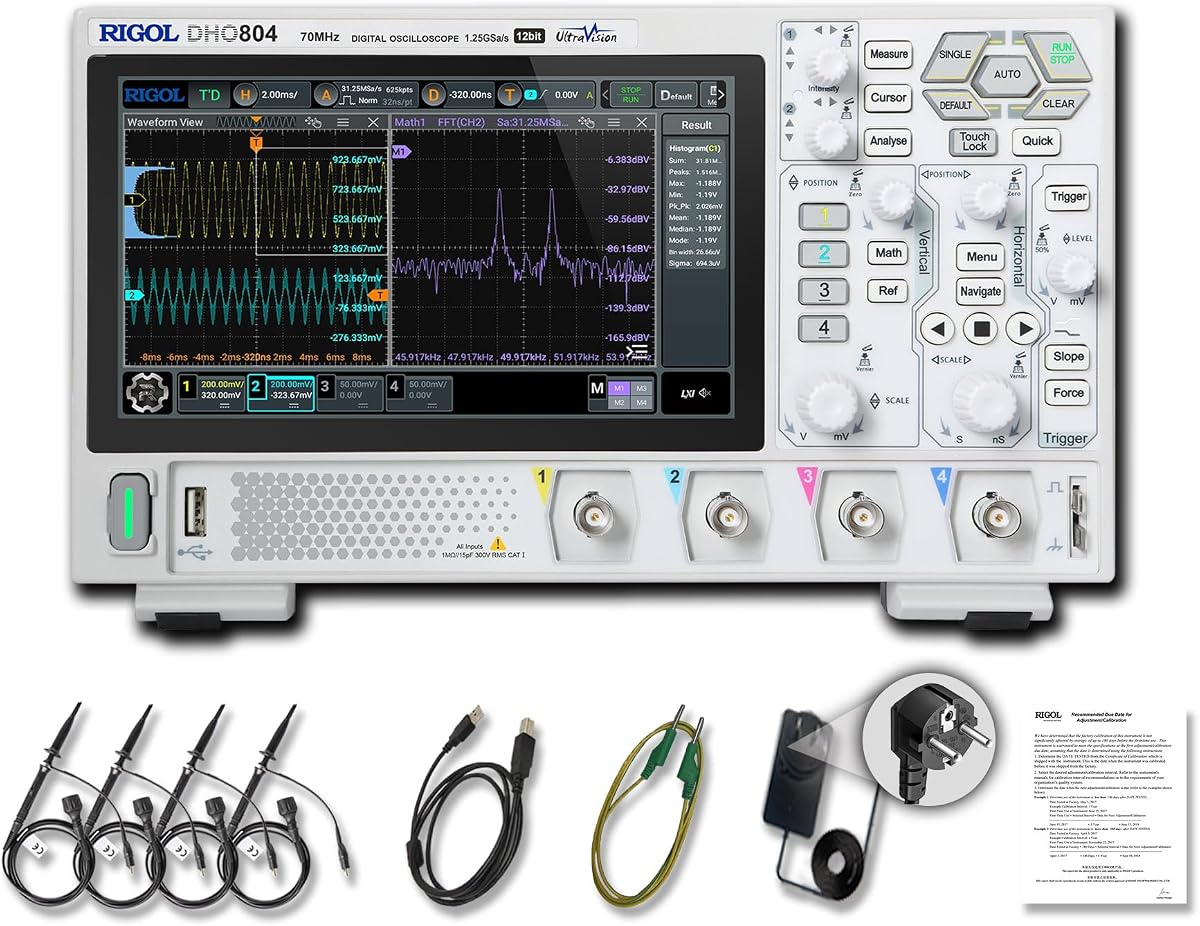
The RIGOL DHO804 delivers professional grade capabilities at a mid-range price. Its 12-bit resolution provides exceptional vertical detail unmatched by cheaper scopes. This makes it ideal for analyzing noise in power supplies and subtle signal variations.
We may earn a commission when you buy through this link, at no additional cost to you.
Features like UltraAcquire capture up to one million waveforms per second helping find intermittent faults quickly. Four channels support complex multi-rail system debugging. Connectivity options include LAN and HDMI for integration into larger lab setups.
The higher cost reflects these advanced features which may be overkill for simple tasks. Its size is larger than handheld units reducing portability. However the performance justifies the expense for serious electronics engineers.
Invest in this scope if you require high fidelity measurements and protocol decoding capabilities. It bridges the gap between hobbyist tools and professional lab equipment perfectly.
The 12-bit ADC reveals voltage nuances that 8-bit scopes obscure aiding precise calibration.
LAN control allows remote operation saving time during long term testing sequences.
We may earn a commission when you buy through this link, at no additional cost to you.
The FNIRSI DSO-510 focuses on signal generation and analysis for low frequency work. Its infinite afterglow feature helps trace rare signal events. As a 2-in-1 tool it provides both capture and output capabilities in a single unit.
We may earn a commission when you buy through this link, at no additional cost to you.
With 10MHz bandwidth it suits audio and basic power analysis. The DDS generator outputs 13 waveforms at up to 50kHz. This dual functionality is useful for testing audio circuits or sensor responses.
The low bandwidth restricts use to slower digital signals. Display resolution is lower than higher end models. These constraints are acceptable for users prioritizing generator integration over speed.
Buy this if you need a portable generator with basic oscilloscope functions. It serves well for teaching signal concepts or debugging simple analog circuits.
Afterglow helps visualize intermittent signals that might otherwise disappear from the screen quickly.
Built-in generator allows you to inject test signals and monitor responses instantly.
We may earn a commission when you buy through this link, at no additional cost to you.
The FNIRSI DPOS350P offers impressive specs like 350MHz bandwidth and 1GSa/s sampling. It integrates spectrum analysis and frequency response tools for deep signal work. This model targets users needing higher performance without professional pricing.
We may earn a commission when you buy through this link, at no additional cost to you.
Its FFT analysis supports EMI checks and signal integrity. The frequency response analyzer is useful for tuning filters. The touchscreen interface allows intuitive navigation through these advanced settings.
Advanced features come with a steeper learning curve. It is more expensive than basic handheld units. These trade-offs are worth it for users needing high bandwidth and analysis capabilities.
Select this for advanced projects involving RF or complex digital protocols. It is a powerful tool for engineers transitioning from hobbyist to professional work.
Built-in FFT tools eliminate the need for an external spectrum analyzer.
Gain and phase measurements streamline analog filter design and loop stability testing.
We may earn a commission when you buy through this link, at no additional cost to you.
The FNIRSI 2C53P features a 4.3 inch IPS touchscreen for easy navigation. It combines oscilloscope multimeter and generator functions. This design appeals to users who prefer touch controls over physical buttons.
We may earn a commission when you buy through this link, at no additional cost to you.
Battery life is supported by a 4000mAh cell for extended field use. The display resolution ensures clear waveform viewing. One-key AUTO simplifies basic operations significantly.
Some users report calibration issues with the touchscreen. User ratings are lower than similar models. These issues can be frustrating but the feature set remains strong.
Consider this if you prioritize a modern interface. It is suitable for general diagnostics where touch interaction enhances efficiency.
Touch controls allow faster parameter adjustments compared to rotary knobs.
IPS technology provides better viewing angles than older LCD types.
We may earn a commission when you buy through this link, at no additional cost to you.
The FNIRSI 1013D Plus brings 100MHz bandwidth to a portable form. Its 7 inch touchscreen offers excellent visibility for complex waveforms. The 1GS/s sampling rate ensures accurate capture of fast signals.
We may earn a commission when you buy through this link, at no additional cost to you.
With a 6000mAh battery it supports long testing sessions. Lissajous graphics allow phase and frequency comparison easily. Storage capacity handles thousands of screenshots for documentation.
It lacks a multimeter function reducing versatility. The size is bulkier than handheld units. However the display quality and bandwidth are compelling for field engineers.
Use this when screen real estate and bandwidth are priorities. It is ideal for automotive and industrial diagnostics where clarity matters.
The 7 inch display allows detailed waveform analysis without straining your eyes.
Lissajous plots make phase difference measurement intuitive and visual.
We may earn a commission when you buy through this link, at no additional cost to you.
The FNIRSI 2C23T is a reliable choice for educational settings. It offers a 3-in-1 design with oscilloscope multimeter and generator. Its high rating reflects solid performance for teaching basic electronics.
We may earn a commission when you buy through this link, at no additional cost to you.
The multimeter supports standard measurements like resistance and continuity. The signal generator outputs seven standard waveforms. FPGA architecture ensures stable waveform capture.
Bandwidth is limited to 10MHz restricting high frequency work. The interface is basic but effective for learning. These limitations are acceptable for classroom environments.
Ideal for schools or beginners needing a multi-tool. It supports curriculum requirements without expensive lab equipment.
Integrated tools allow students to learn measurement basics in one device.
FPGA design ensures consistent performance over time in busy labs.
We may earn a commission when you buy through this link, at no additional cost to you.
The FNIRSI 2D15P combines 100MHz bandwidth with a TRMS multimeter. It offers 13 parameters and 6 math functions for deep analysis. The 5000mAh battery supports extended field work.
We may earn a commission when you buy through this link, at no additional cost to you.
FFT and cursor features help estimate harmonics and measure waveforms accurately. The fan cooling ensures stable operation during long sessions. Type-C charging keeps it powered up easily.
User ratings are slightly lower due to learning curve. Menu navigation can be dense. These are manageable for those willing to invest time in learning.
Choose for a balanced approach to performance and portability. It fits well in workshops needing advanced analysis capabilities.
500MS/s allows capturing sharper edges on digital signals accurately.
Quiet fans prevent thermal drift during prolonged measurement sessions.
We may earn a commission when you buy through this link, at no additional cost to you.
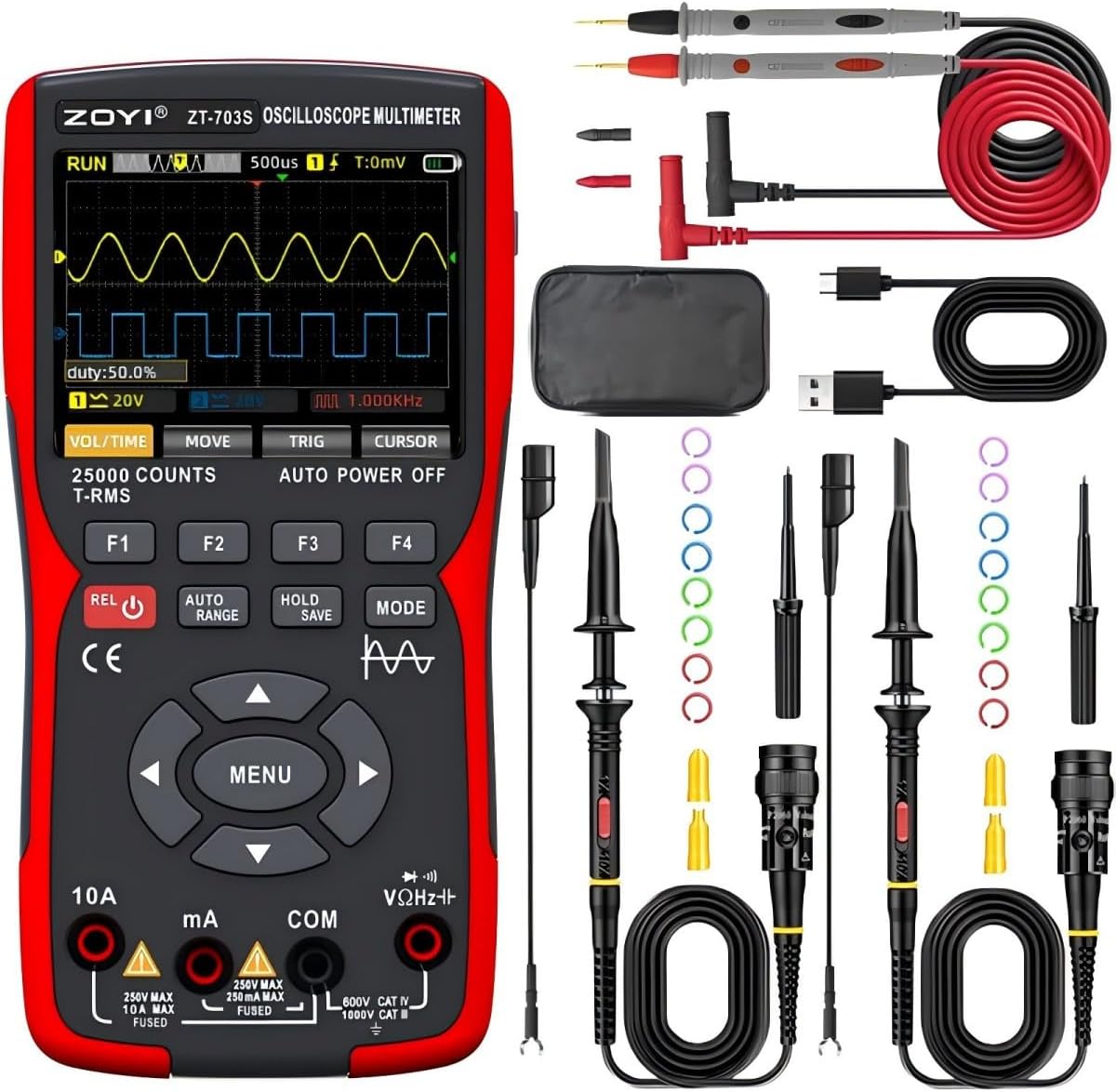
This generic branded scope offers strong features for automotive work. It supports 50MHz bandwidth with dual modes for power efficiency. The multimeter boasts 25000 counts for precision voltage measurement.
We may earn a commission when you buy through this link, at no additional cost to you.
Auto waveform recognition simplifies testing of unknown signals. High speed mode reaches 280MS/s sampling for detailed pulse analysis. Synchronous display aids comparison of output and input signals.
Generic branding means support may vary. Manual is essential for navigation. These are typical trade-offs for competitive pricing.
Ideal for mechanics needing diagnostic versatility. It handles ignition and sensor testing effectively.
Switching modes optimizes battery life during intermittent field checks.
Auto recognition reduces setup time for unknown automotive sensor signals.
We may earn a commission when you buy through this link, at no additional cost to you.
Selecting the right oscilloscope requires balancing cost with technical requirements. This section breaks down key factors to consider before purchasing.
Bandwidth determines the highest frequency signal the scope can measure accurately. For audio or basic power work 20MHz to 50MHz is sufficient. For digital signals higher bandwidth ensures you see the fastest edges without distortion.
Choose a scope with bandwidth at least five times your highest signal frequency for accurate representation.
Sampling rate defines how many times per second the scope captures data points. Higher rates allow more detailed waveform reconstruction. Look for a sampling rate at least five times your bandwidth.
Adequate sampling prevents aliasing and ensures waveform details remain intact during analysis.
Display clarity is essential for reading waveforms clearly. Larger screens like 7 inches offer better visibility in various lighting conditions. Touchscreens can speed up navigation significantly compared to buttons.
Prioritize high resolution screens to reduce eye strain during long diagnostic sessions.
Handheld scopes must balance performance with battery capacity. Look for at least 4 hours of continuous use. Type-C charging is now standard for convenience.
Ensure battery capacity supports your typical field workflow without needing constant recharging.
Many budget models offer multimeter or signal generator functions. These add value by consolidating tools. FFT analysis helps identify harmonics without extra hardware.
Evaluate which extra features align with your workflow to avoid paying for unused capabilities.
Memory depth affects how much data you can store per waveform. Deeper memory allows longer capture times without sacrificing resolution. This is useful for intermittent fault finding.
Aim for at least 32kb record depth for most general applications.
Modern scopes often include USB-C or LAN ports for data transfer. Check if they support waveform export or PC control. This facilitates documentation and remote access.
Connectivity ensures you can share results efficiently after a job.
An intuitive interface reduces setup time. Auto measurement features simplify basic tasks. Look for clear labeling of buttons and menus.
A well designed interface improves productivity during time sensitive repairs.
Always calibrate your probe before starting measurements to ensure accuracy. Connect ground leads securely to avoid noise interference during signal capture.
Use the AUTO button to quickly set baseline measurements when encountering unknown signals. Adjust vertical and horizontal scales manually for precise readings when needed.
Store your oscilloscope in a protective case to prevent screen damage. Keep firmware updated via USB-C to maintain compatibility with new features.
For audio and low frequency digital circuits 20MHz to 50MHz is usually enough. Higher bandwidth is necessary for RF or high speed digital protocols.
Most handheld models support up to 400VPP. Always use probes rated for your voltage level and follow safety protocols to prevent damage.
Most modern models support saving via USB-C or SD cards. Connect to a PC to export screenshots for documentation or analysis.
Integrated multimeters are good for general checks but may lack lab grade precision. Use a dedicated meter for critical calibration tasks.
Sampling rate ensures accurate reconstruction of signal details while bandwidth limits frequency response. Both are needed for faithful waveform capture.
Battery life varies but most offer 4 to 6 hours of continuous use. Carry a power bank for extended field work.
The FNIRSI DSO152 offers the best budget entry point for beginners. The 2C53T provides exceptional value with its all-in-one capabilities.
Prioritize bandwidth and screen quality based on your specific tasks. Don't overlook battery life if you work remotely often.
Prices and availability change frequently so verify current details on the product pages before purchasing to ensure you get the best deal today.