
SIRUI Night Walker 35mm T1.2
4.4Editor score
T1.2 large aperture
S35 coverage design
Lightweight aluminum body
This expert guide compares the top ten cine lens options for filmmakers seeking superior optical performance, manual focus control, and versatile mounting
Cine lenses are essential tools for filmmakers who demand precise manual control and consistent optical quality. Unlike standard photo lenses, they offer smooth focus throws, de-clicked apertures, and uniform build sizes for seamless switching during production.
We evaluated ten standout options based on optical performance, build quality, mount compatibility, and value. Each entry offers unique strengths for different budgets and camera systems, from affordable primes to professional zooms designed for demanding workflows.
Every pick includes detailed specifications, pros and cons, and practical insights to help you choose the right tool. Prices and availability can change, so verify current details before purchasing to ensure you get the best deal for your project.
4.4Editor score
5.0Editor score

5.0Editor score
The following table provides a side-by-side comparison of all ten selected cine lenses. Review key specifications like focal length, aperture range, mount type, and coverage to identify which model aligns best with your camera system and production needs.


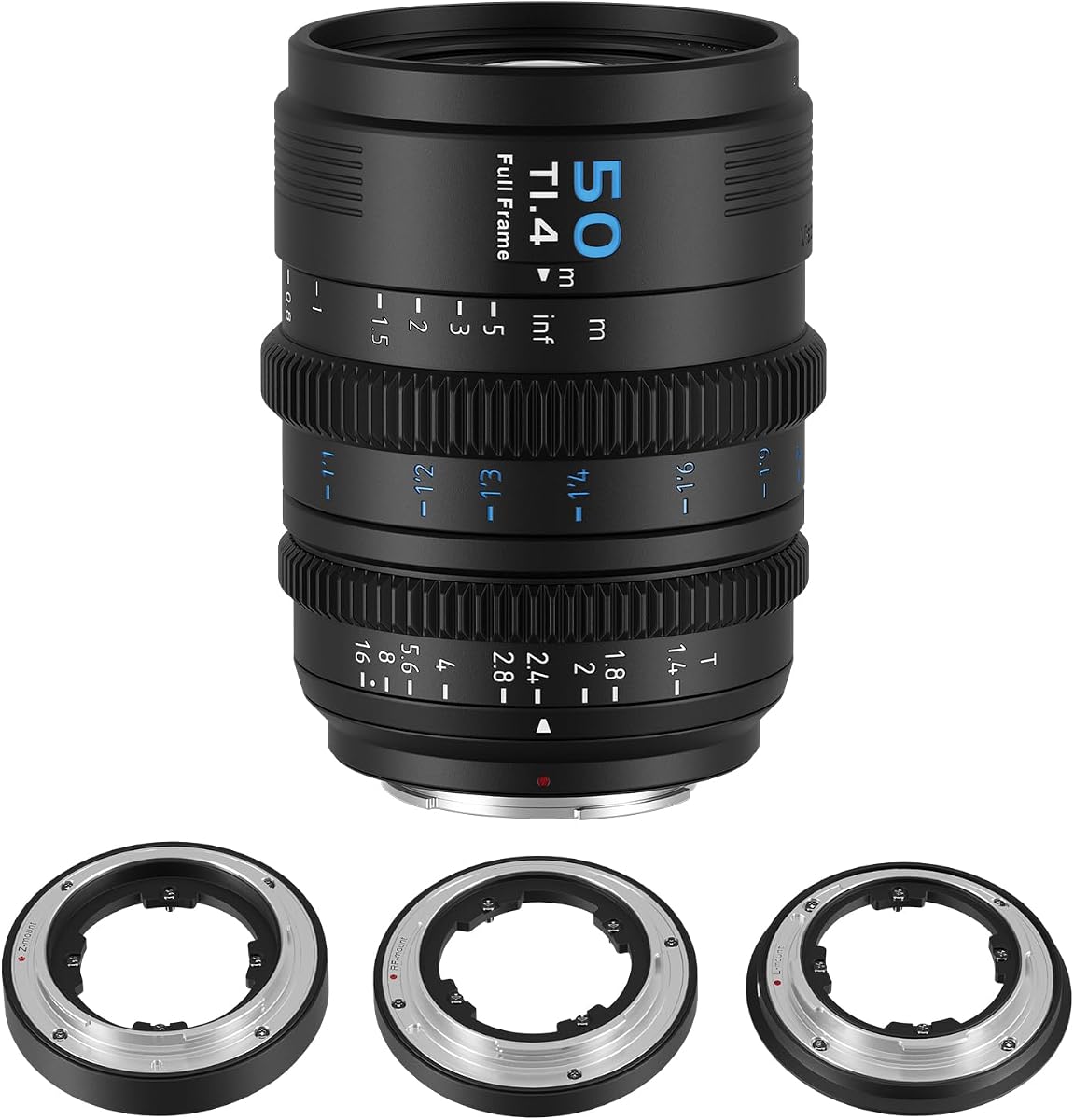


The SIRUI VP-1 Vision Prime 1 50mm T1.4 earns our Editor's Choice for its innovative interchangeable mount system. This full-frame cine lens delivers exceptional sharpness and low-light capability, making it ideal for modern professional filmmaking.
We may earn a commission when you buy through this link, at no additional cost to you.
Its multi-mount versatility allows you to switch between Sony E, Canon RF, Nikon Z, and Panasonic L mounts easily. The optical design integrates aspherical elements and advanced glass to minimize aberrations, ensuring edge-to-edge clarity even at T1.4.
While the lens is compact at around 600 grams, it maintains a durable aluminum alloy body. The uniform design across the set ensures consistent color, tone, and gear positions for streamlined production workflows.
This lens is perfect for filmmakers needing flexibility without compromising optical quality. Its fast aperture and 8K readiness make it a strong investment for hybrid shooters and indie productions.
The pre-installed E mount with user-interchangeable RF/Z/L options lets you adapt quickly to different camera bodies.
Engineered with ED and HRI glass to maintain sharpness and reduce chromatic aberrations for 8K storytelling.
We may earn a commission when you buy through this link, at no additional cost to you.
The SIRUI Night Walker 35mm T1.2 offers outstanding value for photographers needing a fast manual focus lens. With a massive T1.2 aperture, it excels in low-light environments while producing beautiful background separation.
We may earn a commission when you buy through this link, at no additional cost to you.
Its optical performance is impressive for the price, achieving perfect sharpness even at maximum aperture. The focus breathing is minimal, ensuring smooth pulls during video recording without distracting frame shifts.
Weighing around 500 grams, this lens is sturdy yet portable. The aluminum cine housing protects internal elements while maintaining a compact form factor suitable for handheld or gimbal use.
Ideal for documentary and portrait work on S35 sensors, this lens delivers cinematic aesthetics without breaking the bank. It is a top pick for budget-conscious creators who refuse to compromise on optical quality.
Shoot pure low noise night scenes without excessive ISO thanks to the ultra-fast T1.2 aperture design.
The fast aperture contributes to pleasing bokeh quality and clear subject separation for expressive footage.
We may earn a commission when you buy through this link, at no additional cost to you.
The DZOFILM Pictor 50-125mm T2.8 is a premium zoom lens designed for serious filmmakers. Its parfocal design ensures focus stays locked throughout the zoom range, which is critical for professional production.
We may earn a commission when you buy through this link, at no additional cost to you.
This lens features a 16-slat iris for smooth aperture control and minimal focus breathing. The optical design maintains high sharpness across the entire range, supporting a wide aperture of T2.8 to T25.
Built to match standard cine lens accessories, it fits seamlessly into established workflows. The robust construction ensures durability while delivering consistent performance in demanding shooting environments.
Best for studios and pro productions requiring a reliable zoom with prime-like quality, this lens justifies its investment through exceptional optical performance and mechanical precision.
Maintains focus across the entire zoom range for smooth, uninterrupted shooting during complex scenes.
A 16-slat iris provides precise aperture adjustments with minimal impact on depth of field.
We may earn a commission when you buy through this link, at no additional cost to you.
This Rokinon Cine DS kit includes four essential primes: 24mm, 35mm, 50mm, and 85mm. It provides a complete solution for full-frame Canon EF users seeking professional cine performance.
We may earn a commission when you buy through this link, at no additional cost to you.
All lenses in the set are color matched and share unified gear and aperture positions. This consistency simplifies production workflows and ensures uniformity across different shots.
The multi-layer coating reduces flare, while dual side focus and T-stop scales allow for precise manual operation. The de-clicked aperture ring supports smooth exposure transitions during filming.
Ideal for productions needing a full set of primes without matching individual lenses later. This kit balances high-end features with comprehensive coverage for versatile storytelling.
Color matched lenses with unified gear positions streamline production and reduce setup time.
Dual side focus and T-stop scales provide essential tools for accurate manual focus and exposure.
We may earn a commission when you buy through this link, at no additional cost to you.
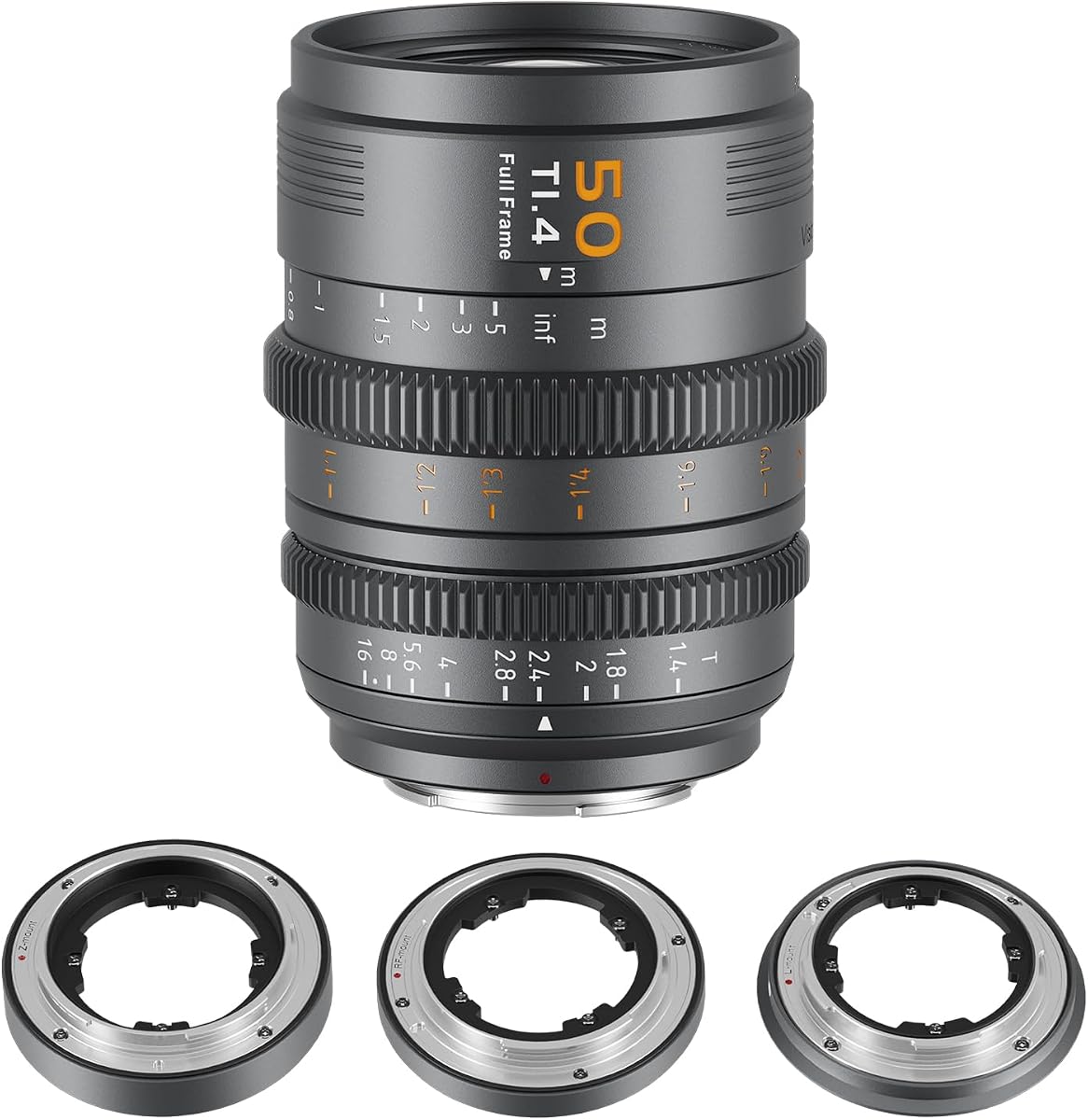
The SIRUI VP-1 Vision Prime 1 50mm T1.4 is designed with a creative interchangeable mount system. This full-frame cine lens delivers edge-to-edge sharpness for high-resolution filmmaking.
We may earn a commission when you buy through this link, at no additional cost to you.
Its optical design integrates aspherical elements and advanced glass to minimize distortion. The T1.4 aperture enables low-light shooting while maintaining nuanced image details and soft bokeh.
With a durable aluminum alloy body weighing around 600g, this lens offers effortless stabilization. The uniform design across the set allows for easy swapping and high consistency in production.
Best for travelers and gimbal users who need reliable optics without bulk. This lens ensures consistent color and tone when paired with other lenses in the series.
Built with a durable aluminum alloy body, making it perfect for travel and handheld filmmaking.
The ultra-wide aperture enables you to shoot in low-light conditions without excessive ISO.
We may earn a commission when you buy through this link, at no additional cost to you.
The Rokinon Cine DS 85mm T1.5 is a versatile portrait lens offering full-frame coverage with a T1.5 aperture. It provides a 28.3 degree angle of view on full-frame sensors.
We may earn a commission when you buy through this link, at no additional cost to you.
This lens features unified gear and aperture positions, making it color matched with other DS lenses. The 8 blade iris creates attractive bokeh for creative focus control.
With a minimum focusing distance of 3.6 feet and a 72mm filter size, it handles well in various scenarios. The lightweight design makes it easy to manage on gimbals or rigs.
Best for portrait and close-up work on Canon EF cameras, this lens offers consistent optics and build quality without compromising on speed or coverage.
New DS line that is color matched with unified gear and aperture positions among all Rokinon Cine DS lenses.
Features an 8 blade iris for creating attractive bokeh and smooth background separation.
We may earn a commission when you buy through this link, at no additional cost to you.
This 35mm T1.5 lens offers a 63.1 degree angle of view on full frame. It is part of the new DS line with unified gear positions for streamlined operation.
We may earn a commission when you buy through this link, at no additional cost to you.
Color matched with other DS lenses, it ensures consistency when switching focal lengths. The aperture range of T1.5 to T22 provides flexibility for various lighting conditions.
With a minimum focusing distance of 12 inches and a 77mm filter size, it is adaptable for close-ups and landscapes alike. The design supports reliable performance on Canon EF cameras.
Ideal for shooters needing a fast wide-angle option, this lens combines practical features with strong optical consistency.
The new DS line has unified gear and aperture positions among all Rokinon Cine DS lenses for consistency.
Minimum focusing distance of 12 inches allows for tighter framing and creative close-up shots.
We may earn a commission when you buy through this link, at no additional cost to you.
The 24mm focal length delivers a versatile S35 perspective for landscapes and street scenes. It balances a broad field of view with natural-looking composition.
We may earn a commission when you buy through this link, at no additional cost to you.
The bright T1.2 aperture captures more light in challenging conditions while creating shallow depth of field. Focus as close as 0.3m for immersive environmental close-ups and creative shots.
Advanced optical design delivers high sharpness with controlled aberration. The 270 degree focus rotation enables smooth, precise, and repeatable manual focusing for video production.
Ideal for RED Komodo and Canon EOS R7 users seeking a reliable wide-angle option. This lens offers precise control and expressive cinematic results in a compact form.
Compatible with RED KOMODO, EOS R7, R10, C70, and R50, making it a versatile S35 cine lens.
Focus as close as 0.3m to capture subjects with greater depth and visual impact.
We may earn a commission when you buy through this link, at no additional cost to you.
This Night Walker 24mm lens is equivalent to a 34mm full frame lens on M4/3 cameras. It is suitable for landscape, street, and scene filming with excellent optics.
We may earn a commission when you buy through this link, at no additional cost to you.
Featuring a large T1.2 aperture, it is perfect for low-light filming without excessive ISO. The optical performance achieves perfect sharpness and minimal focus breathing.
The strong aluminum cine housing makes it sturdy yet portable. The minimum weight is around 500g, creating a new era of lightweight fast aperture lens options.
Perfect for users of BMPCC4K or GH6 who need a lightweight, fast lens. It delivers pure low noise night scenes and pleasing bokeh quality for expressiveness.
Improves optical performance at even the max aperture with minimal focus breathing and well controlled aberration.
Strong aluminum cine housing makes it sturdy yet portable while protecting inner optical elements.
We may earn a commission when you buy through this link, at no additional cost to you.
Optically constructed of 9 elements in 7 groups, this lens offers robust performance. The aperture range extends from T1.5 to T34 with 9 aperture blades for attractive bokeh.
We may earn a commission when you buy through this link, at no additional cost to you.
It uses a 72mm filter size and features ultra multi-coated glass to enhance image quality. The angle of view is 28.4 degrees on full frame and 19.1 degrees on APS-C.
This purpose-built lens combines focal length, aperture, focus, and mount configuration for specific use cases. It provides a strong option for portrait work with precise control.
Ideal for filmmakers on Canon EF seeking a reliable, fast portrait lens. It delivers consistent results and high-quality optics for professional projects.
Optical design & compatibility combining the listed focal length, aperture, focus, and mount configuration in one purpose-built lens.
Aperture range of T1.5 to T34 with 9 blades for attractive bokeh and smooth transitions.
We may earn a commission when you buy through this link, at no additional cost to you.
Selecting the right cine lens depends on your camera system, focal needs, and workflow requirements. Understanding key features ensures you invest in optics that enhance your footage without unnecessary complications.
Ensure your lens mount matches your camera body. Modern systems often require adapters or interchangeable mounts like SIRUI’s VP-1 series for flexibility across brands.
Check the manufacturer’s compatibility list before purchasing to avoid unnecessary adapters or mount issues.
Full-frame lenses cover larger sensors, while S35 or APS-C lenses are designed for smaller formats. Using a smaller circle on a full-frame camera may result in vignetting.
Match the lens image circle to your camera’s sensor size for optimal framing and edge-to-edge sharpness.
Fast apertures like T1.2 or T1.5 allow more light, improving low-light performance and enabling shallow depth of field. Slower apertures may limit flexibility in dim conditions.
Prioritize wider apertures if you shoot in varied lighting or want strong background separation.
Cine lenses typically feature long, smooth focus throws (e.g., 270 degrees) for precise manual control. Photo lenses often have short throws unsuitable for video focus pulls.
Look for de-clicked aperture rings and standardized gear positions for consistent operation during production.
High-quality glass like ED or aspherical elements reduces chromatic aberration and distortion. Sharpness at maximum aperture and minimal focus breathing are critical for professional results.
Choose lenses engineered for 8K or high-resolution capture if your workflow demands future-proof quality.
Lightweight aluminum bodies aid handheld or gimbal use, while heavier builds may offer durability. Consider your typical shooting style and stabilization needs when selecting a lens.
Aim for a balance between robust construction and manageable weight for your rig.
Kits may offer better value than individual lenses. Evaluate the cost per focal length versus standalone prices to determine the best investment for your needs.
Budget options can deliver excellent performance if you prioritize essential features over brand prestige.
Uniform size, weight, and color tone simplify switching lenses during shoots. Matched gear positions reduce rig adjustments and improve workflow efficiency.
Choose a line that offers consistent design elements if you plan to own multiple focal lengths.
Always attach your lens to a stable rig or tripod for smooth focus pulls. Use the standardized gear positions for focus and aperture rings to connect follow focus units effectively.
Clean lens elements gently with a microfiber cloth and lens pen. Avoid harsh chemicals and store the lens in a dry, padded case to protect the glass and internal mechanisms.
Regularly update firmware for any electronic components and calibrate focus scales if your system requires it. Proper storage and handling extend the lifespan of your optics.
Cine lenses have smooth focus throws, de-clicked apertures, and standardized gear positions. They also typically offer consistent size and color across a series for professional workflows.
Yes, many work with autofocus cameras via adapters or manual focus. They offer manual control but remain fully functional on modern hybrid bodies.
T-stops measure actual light transmission, ensuring consistent exposure across lenses. This is crucial for video where matching shots is essential.
Full-frame cine lenses work on crop sensors, often with a crop factor. S35 lenses are specifically optimized for smaller sensors.
Cine lenses have long focus throws for precise control. Practice is needed, but they offer superior smoothness compared to still lenses.
With proper adapters and mounts, yes. However, most require dedicated smartphone rigs for optimal performance and alignment.
We highlighted top picks like the SIRUI VP-1 for versatility and the DZOFILM Pictor for premium zoom performance. Each lens offers distinct benefits based on your mount, budget, and production needs.
Prioritize optical consistency, mount compatibility, and aperture speed. A well-matched lens set improves workflow and footage quality significantly.
Verify current prices and availability before purchasing to ensure you get the best deal for your project needs.