
DIGITEN G1.5" Water Flow Sensor
5.0Editor score
Wide 5-150L/min range
Robust pressure resistance
ROHS certified materials
Choosing the right Arduino Flow Meter is essential for any project involving fluid dynamics or water usage monitoring. These devices help track consumption rates accurately and integrate seamlessly with microcontrollers like the Arduino Uno or Raspberry Pi for automated control systems.
We analyzed ten leading products based on their flow range, build quality, and compatibility with common DIY electronics setups. Each option offers unique features tailored to different applications ranging from home brewing to industrial water management and smart irrigation systems.
Each pick highlights key strengths such as pulse output reliability and thread compatibility. Please note that pricing and availability can change rapidly so always check the latest listings before making your final purchase decision for your specific needs.
5.0Editor score

4.7Editor score

4.5Editor score
As an Amazon Associate we earn from qualifying purchases.
This side by side comparison highlights the key specifications and features of the top rated flow sensors available for Arduino projects today ensuring you find the perfect match.


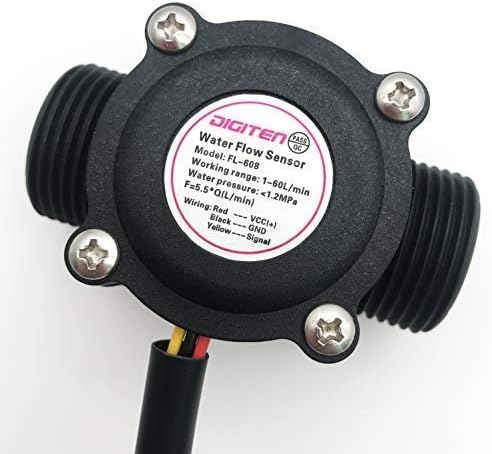
This sensor offers a balanced performance for most general Arduino projects with a robust 4.7 rating from users. It features a sealed hall effect sensor that ensures durability when exposed to water systems.
We may earn a commission when you buy through this link, at no additional cost to you.
The integrated magnetic hall effect sensor outputs pulses accurately with every revolution of the turbine inside. This design keeps the electronics dry and safe from direct water contact.
While the flow direction must be observed during installation it is a standard requirement for this type of turbine sensor. Proper orientation ensures consistent signal generation for your microcontroller.
It is ideal for hobbyists needing a reliable flow meter for coffee machines or water filters without spending extra on industrial grade parts.
The hall sensor is completely sealed from the water pipe ensuring long term reliability in wet environments.
The NPT thread allows for a secure and straightforward connection to standard plumbing systems without complex adapters.
We may earn a commission when you buy through this link, at no additional cost to you.
This unit stands out with a near perfect 4.9 rating and is particularly well suited for water testing and cooling system monitoring. Its high amplitude signal ensures clear data for your Arduino.
We may earn a commission when you buy through this link, at no additional cost to you.
The electrical strength of 1250V/min provides robust isolation between the fluid and the sensor electronics. This feature is critical for maintaining safety in high voltage or sensitive applications.
Users appreciate the high amplitude output which makes signal processing easier with microcontrollers that require stronger logic levels. It performs well in vending machines and water heaters.
Buy this if you need a sensor with superior electrical specs for industrial or semi industrial setups where signal integrity is paramount.
The high amplitude output ensures your microcontroller receives clear signals even in electrically noisy environments.
Designed for use in water cooling systems where reliable flow detection prevents overheating of components.
We may earn a commission when you buy through this link, at no additional cost to you.
With a perfect 5.0 rating this sensor handles high flow rates up to 150 liters per minute which is rare in hobby grade parts. It is built for larger systems like irrigation or industrial filtering.
We may earn a commission when you buy through this link, at no additional cost to you.
The material aligns with ROHS testing standards making it safe for potable water applications. You can trust it for drinking water systems without worrying about chemical leaching.
Its working voltage range of 5 to 18 volts offers flexibility in power supply choices. The square wave output provides clean pulses for counting in your Arduino sketch.
Choose this model if you need a durable and large capacity sensor for serious water management projects involving high volume throughput.
The sensor can withstand water pressures up to 1.75 Mpa ensuring it holds up under demanding conditions.
All materials are ROHS compliant making this unit safe for use in drinking water systems.
We may earn a commission when you buy through this link, at no additional cost to you.
This sensor is explicitly rated for food grade use which is essential for any project involving drinking water or beverages. It uses raw materials conforming to ROHS test standards for safety.
We may earn a commission when you buy through this link, at no additional cost to you.
The working voltage supports up to 24V which gives you flexibility if you are powering it directly from a larger power rail. The flow range is standard for home applications.
While the rating is lower than some competitors it offers a solid entry point for food grade monitoring. The compact design fits easily in tight spaces like under a sink.
It is a great choice for budget conscious builders who need a safe sensor for coffee makers or drinking fountains without extra cost.
Made from food grade plastic safe for use in any system where human consumption is involved.
Operates reliably across a wide voltage range from 5 to 24 volts for flexible power setups.
We may earn a commission when you buy through this link, at no additional cost to you.
The transparent valve body allows you to visually observe the rotor condition and water flow which is unique in this price range. This helps in quick troubleshooting of flow issues.
We may earn a commission when you buy through this link, at no additional cost to you.
It includes stainless steel beads in the impeller for wear resistance and a longer lifespan. The two pack option adds value if you need to test multiple locations.
Users note that while the design is practical the overall reliability is lower than premium brands. Ensure you seal it properly to avoid leaks at the connection points.
Buy this when you want to see the flow happening inside the sensor or need spare units for a multi sensor setup.
The transparent body allows you to see the water flow and rotor movement for easy visual monitoring.
This listing includes two sensors giving you a spare unit for testing or dual channel monitoring projects.
We may earn a commission when you buy through this link, at no additional cost to you.
This model features a G1/4 inch connector designed for hosepipes with a 5 to 7mm inner diameter. It is ideal for low flow applications where precision is key.
We may earn a commission when you buy through this link, at no additional cost to you.
The flow range is limited to 6 liters per minute which suits small systems like drip irrigation or beverage dispensers. The food grade plastic ensures safety for consumables.
Because of the small connector you must ensure your tubing matches the inner diameter specifications. It works well with Arduino systems monitoring small water usage.
Select this sensor if you are working on a small scale project with low volume fluid movement and need food safe materials.
Designed for standard hosepipes with a 5 to 7mm inner diameter for flexible tubing connections.
Optimized for low flow rates between 0.5 and 6 liters per minute for precision applications.
We may earn a commission when you buy through this link, at no additional cost to you.
This sensor has a perfect 5.0 rating and is often used in water heater systems to detect influent flow rates accurately. It relies on a magnetic rotor that changes speed with flow.
We may earn a commission when you buy through this link, at no additional cost to you.
The hall sensor outputs a pulse signal that feeds back to the controller to regulate heating elements based on flow. This helps prevent overheating when water stops moving.
Its compact design fits into tight spaces like water inlet ends without blocking too much pipe space. The pulse feedback mechanism is reliable for Arduino logic.
This is the top pick for water heater modifications where detecting flow presence is critical for safety and control systems.
The magnetic rotor rotates at speeds proportional to flow rate providing reliable data for your controller.
Feeds pulse signals back to your Arduino to determine water flow magnitude and regulate system response.
We may earn a commission when you buy through this link, at no additional cost to you.
This unit comes with a 1.2 meter cable which makes routing easier if your Arduino is not right next to the pipe. The SM2.54 connector is secure and easy to disconnect.
We may earn a commission when you buy through this link, at no additional cost to you.
It maintains the robust build quality of the G1.5 model but in a smaller package. The square wave output is clean and easy to read with digital pins on your board.
The waterproof design ensures longevity even if installed in a damp area like a basement. It works well for reverse osmosis filters where space is tight.
Choose this model if you need extra cable length to reach your microcontroller without adding extra extension wires.
Includes a 1.2 meter cable making it easy to route signals away from the wet area safely.
The SM2.54 3P connector ensures a stable electrical connection to your board or breakout.
We may earn a commission when you buy through this link, at no additional cost to you.
This sensor is smaller with a G3/8 inch thread fitting it into tight spots where larger sensors won't work. It maintains the same waterproof and resistance features as bigger models.
We may earn a commission when you buy through this link, at no additional cost to you.
It operates on lower voltage starting at 3.5 volts which makes it easy to power with battery setups. The flow range is decent for general home projects.
The output waveform is a standard square wave pulse signal that Arduino counts easily. It is robust enough for cold or hot water environments.
This is the ideal pick if you need a compact sensor for smaller pipes or limited installation space.
The G3/8 inch thread allows this sensor to fit into smaller pipes and tight spaces easily.
Operates efficiently starting from 3.5 volts making it suitable for battery powered projects.
We may earn a commission when you buy through this link, at no additional cost to you.
This sensor has a G3/4 inch thread allowing it to be used with larger pipes common in main water lines. It handles a flow range up to 60 liters per minute.
We may earn a commission when you buy through this link, at no additional cost to you.
It includes a 1.2 meter cable and supports pressures up to 1.75 Mpa. The hall effect sensor provides reliable pulse output for Arduino counting.
While the rating is lower it offers a rare large size option for hobbyists working on bigger plumbing projects. The materials are ROHS compliant and safe for water.
Select this unit when your project involves larger diameter pipes that cannot fit smaller G1/2 or G3/8 sensors.
The G3/4 inch thread accommodates larger pipes found in main water lines and industrial setups.
Includes a 1.2 meter cable to reach your microcontroller from a distance without signal loss.
We may earn a commission when you buy through this link, at no additional cost to you.
Selecting the right flow meter depends on your specific application requirements and technical constraints. Here are the key factors to consider before purchasing.
The flow rate range determines the minimum and maximum liquid volume the sensor can measure accurately. Always check the liters per minute specification to ensure it matches your expected flow speed.
Choose a sensor with a range that covers your application needs without being too high or too low.
Thread size is critical for connecting the sensor to your pipes or fittings. Common sizes include G1/2, G3/8, and G3/4. Ensure you have the right adapters for your plumbing.
Match the thread size to your existing pipe diameter to avoid leaks or expensive adapters.
Most sensors work between 5V and 24V but some start lower at 3.5V. If you power your Arduino from a battery or low voltage source pick a sensor that supports it.
Verify the working voltage matches your power supply to prevent damage or erratic readings.
Hall effect sensors output a square wave pulse signal that is easy to count with Arduino interrupts. This type of signal is robust and immune to magnetic interference.
Prefer sensors with a square wave output for simple integration into your microcontroller code.
Cable length affects where you can place the sensor relative to your Arduino. Longer cables allow flexible routing but may need shielding to avoid noise.
Consider the physical distance between your sensor and controller when selecting a model with a built-in cable.
If you measure water intended for drinking or food processes ensure the sensor is food grade and ROHS compliant. This prevents chemical contamination from plastic parts.
Always check for food grade labels if the sensor will touch consumable liquids.
Pressure resistance is the maximum water pressure the sensor can withstand. Industrial systems may need higher pressure ratings like 1.75 MPa.
Select a sensor that can handle the pressure of your system to avoid physical damage.
Look for models with sealed components and clear direction indicators. A compact design helps in fitting into tight spaces without requiring complex tools.
Prioritize sensors that are easy to install and have a robust build to reduce installation time.
Install the sensor in the water line ensuring the flow direction arrow points downstream. Secure the connection tightly and use thread seal tape if needed to prevent leaks.
Wire the signal pin to an interrupt pin on your Arduino board for accurate pulse counting. Use a pull-up or pull-down resistor as specified in your code or sensor docs.
Periodically check the sensor for debris or wear especially in dirty water systems. If the signal drops or becomes erratic flush the pipe or replace the unit.
An Arduino Flow Meter uses a small turbine inside a plastic body that spins when water flows through it. A hall effect sensor counts the spins and sends pulses to the Arduino to calculate flow rate.
Most sensors listed can handle hot water within specific temperature limits. Always check the product documentation for temperature ratings before using them with hot liquids.
You do not need a specific library but you will use the interrupt attach function in your Arduino sketch to count pulses accurately from the sensor.
Yes many of these sensors are specifically designed to be compatible with reverse osmosis filter systems due to their compact size and durability.
Check the flow direction and ensure water is actually moving through the sensor. Also verify your wiring and power supply are connected correctly to the hall effect pin.
It is not recommended to use standard hall sensors with salt water as it can corrode the plastic and metal parts quickly. Use only for fresh water.
The top picks like the DIGITEN G1.5 and the 1/2 Flow Hall Sensor offer excellent reliability and range for most projects. They balance performance with affordability effectively.
Prioritize thread size and flow range when buying to avoid compatibility issues. Ensure your power supply meets the voltage requirements of your chosen sensor.
Remember that prices and stock change regularly so check the links provided to confirm current availability. Select the one that fits your project needs best today.