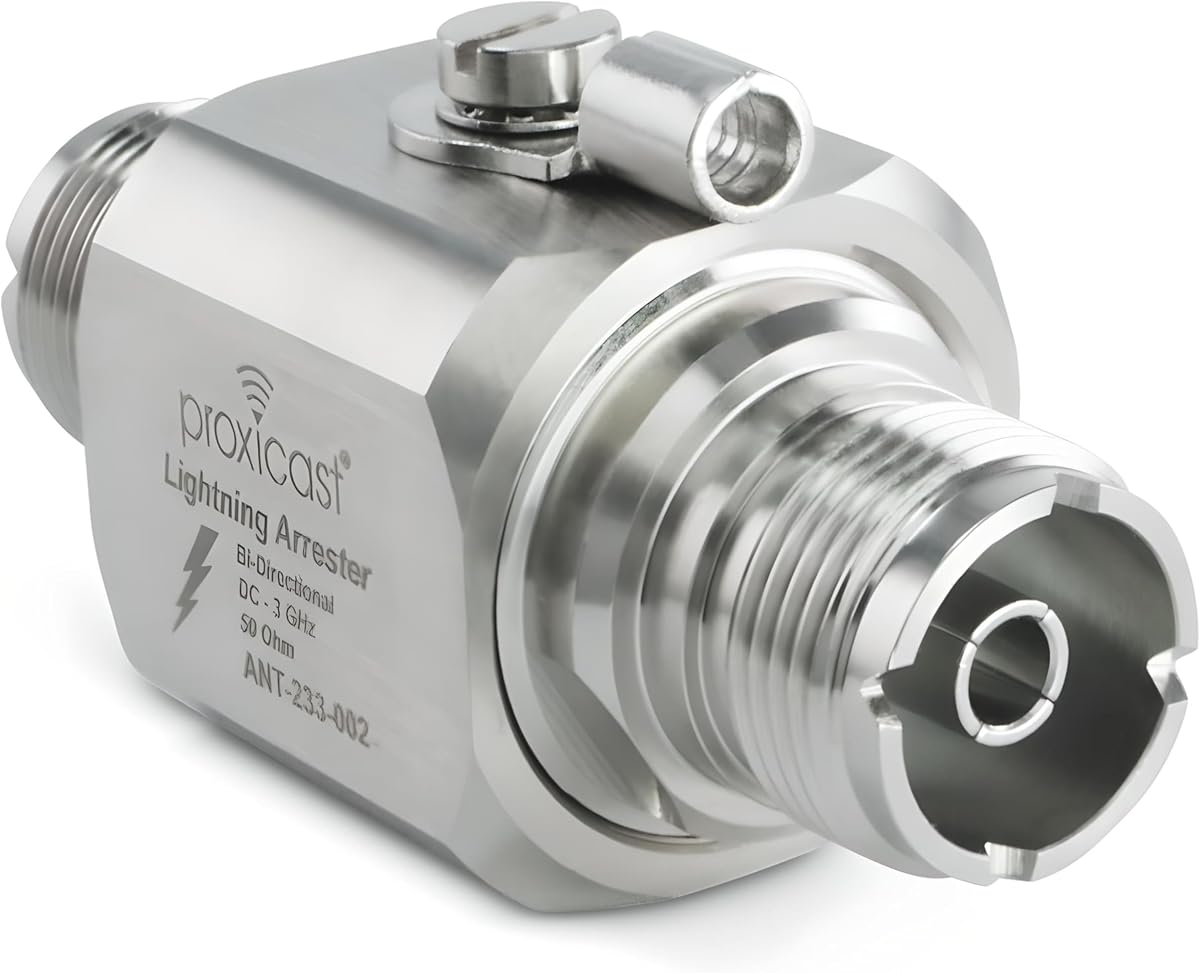
Proxicast ProGrade 230V Coaxial Lightning Arrester – UHF SO-239 / SO-239
4.6Editor score
SO-239 connectors
50 ohm impedance
230V gas discharge
This guide compares the top antenna lightning arrestor models for protecting radios, cell boosters, and satellite dishes from surge damage and electrical
Protecting your electronic equipment from sudden voltage spikes is essential for long-term reliability. A high-quality antenna lightning arrestor diverts dangerous surges safely to the ground before they reach sensitive components.
We evaluated ten top-rated models based on impedance matching, frequency range, and construction durability. Each unit was assessed for insertion loss, grounding options, and compatibility with common connector types.
Every selection includes key specs and real-world application notes to help you match the right protector to your system. Prices and availability may change, so verify details before finalizing your purchase.
4.6Editor score

4.8Editor score

4.8Editor score
The table below provides a side-by-side view of connector types, frequency ranges, and impedance values for every model under review.


The RAIGEN Lightning Arrestor stands out for its exceptional wideband performance and professional-grade build. With a 4.8 rating, this unit handles frequencies from DC up to 6GHz, making it ideal for modern IoT devices, cell boosters, and ham radio setups.
We may earn a commission when you buy through this link, at no additional cost to you.
Its insertion loss is less than 0.1dB, ensuring minimal signal degradation even at high frequencies. The replaceable 90V gas discharge tube offers multi-strike capability, providing long-term protection without needing full replacement after a single event.
While it requires a separate ground cable for complete safety, the included ground lug simplifies installation. The heavy-duty brass nickel-plated body ensures durability against outdoor elements, and the Teflon insulation protects the inner core from environmental stress.
This arrestor is best suited for users who need a versatile protector for multiple device types. Its balance of performance, durability, and modularity makes it a top choice for professional and serious hobbyist deployments.
Supports 2G through 5G LTE, LoRa, WiFi, and CB bands, allowing one device to protect diverse wireless networks.
Constructed for permanent outdoor mounting with weatherproof seals and a robust brass-plated connector for reliable RF continuity.
We may earn a commission when you buy through this link, at no additional cost to you.
The Proxicast ProGrade SO-239 arrestor delivers reliable protection for CB and amateur radio at a very accessible cost. Its 4.6 rating reflects consistent performance in diverting high-voltage surges away from sensitive receivers.
We may earn a commission when you buy through this link, at no additional cost to you.
Using a 230V gas discharge tube, it shunts damaging energy to ground with very low RF insertion loss. The 50 ohm impedance matches standard amateur radio systems, ensuring minimal signal attenuation across the VHF and UHF bands.
Though it does not include a ground cable, the bulkhead design allows easy integration into existing systems. The bi-directional protection ensures safety regardless of surge direction, while DC pass-through supports powered antennas.
Ideal for budget-conscious ham operators or CB users, this unit provides essential protection without unnecessary complexity. It balances cost and function effectively for lower-frequency base station setups.
Uses SO-239 connectors commonly found on most CB and amateur radio transceivers and base antennas.
Offers essential safety features for a price that fits well within entry-level amateur radio budgets.
We may earn a commission when you buy through this link, at no additional cost to you.
The Diamond Antenna SP3000 represents top-tier protection for serious ham operators and professional installers. With a 4.8 rating, it offers robust 200W power handling and a frequency range covering DC to 3000MHz.
We may earn a commission when you buy through this link, at no additional cost to you.
Designed with N-Type female connectors, it integrates easily into high-performance antenna systems. Its impulse wave discharge capacity ensures safety during severe storms, while low insertion loss preserves signal integrity for critical communications.
Although priced higher than basic models, the SP3000 justifies the cost with superior construction and reliability. It is specifically built to withstand the rigors of outdoor mounting and repeated electrical events.
For users prioritizing long-term durability and brand reputation, this arrester is a premium choice. It suits high-power transceivers and setups where failure is not an option.
Handles up to 200W continuous power, making it safe for high-output amateur and commercial radio operations.
Diamond Antenna is a recognized name in RF accessories, ensuring consistent performance and durable materials.
We may earn a commission when you buy through this link, at no additional cost to you.
The Diamond SP1000 is engineered to protect mobile and base station radios from lightning damage. Its 4.6 rating highlights consistent performance in maintaining signal integrity while diverting high-voltage spikes safely to ground.
We may earn a commission when you buy through this link, at no additional cost to you.
With an insertion loss under 0.3dB and impulse capacity of 6000 Amps, it offers strong protection without compromising RF quality. The replaceable surge arrester element extends the device's useful life after a strike.
Constructed from weather-resistant materials, it withstands outdoor exposure on vehicles or towers. It is designed for easy integration into existing antenna systems, ensuring dependable operation during severe weather.
Ideal for users who need reliable surge protection for vehicle or stationary setups, this model balances performance and convenience. It is a solid investment for equipment that cannot afford downtime.
Features a replaceable arrester element, allowing continued use after a single strike rather than full unit replacement.
Ensures signal strength remains high across wideband frequencies, critical for clear communications and data transmission.
We may earn a commission when you buy through this link, at no additional cost to you.
The Proxicast ProGrade N-Male N-Female arrester provides effective protection for modern 4G, 5G, and WiFi systems. Its 4.4 rating reflects reliable performance in safeguarding modems, boosters, and access points from lightning-induced surges.
We may earn a commission when you buy through this link, at no additional cost to you.
Covering a wide range from DC to 6GHz, it handles everything from GPS to 5GHz WiFi. The bi-directional protection and very low insertion loss ensure that signal quality remains high while electrical safety is maintained.
Its N-type connectors support secure panel or bulkhead mounting. The 230V gas discharge tube shunts damaging surges to ground, with multi-strike capability offering lasting protection.
Best suited for users with mixed connectivity needs, this model offers flexibility across cellular and wireless bands. It is a practical solution for protecting home internet or IoT infrastructure.
Supports 900MHz radios, 4G/5G modems, and 2.4/5GHz WiFi, making it versatile for modern networks.
Designed for secure panel or bulkhead mounting, allowing neat installation through enclosures or walls.
We may earn a commission when you buy through this link, at no additional cost to you.
This N-type lightning arrestor delivers strong value with a 4.7 rating and broad frequency support. It protects GPS, 4G/5G, and WiFi antennas while maintaining low insertion loss for clear signal transmission.
We may earn a commission when you buy through this link, at no additional cost to you.
Using a replaceable 90V gas discharge tube, it diverts surges safely to ground. Its 50 ohm impedance ensures compatibility with most outdoor antennas, and its bi-directional protection covers both surge directions.
The unit is designed for panel or bulkhead mounting, allowing secure integration. While it requires a separate ground cable, the simple structure and affordable price make it accessible for many users.
Ideal for homeowners protecting cellular boosters or outdoor WiFi access points, this model offers essential safety at a budget-friendly price. It balances performance and affordability effectively for entry-level installations.
Covers 3G to 5G LTE, GPS, and 2.4/5GHz WiFi in one affordable device for diverse outdoor setups.
Allows easy panel or bulkhead installation, ideal for keeping connections secure and weatherproof.
We may earn a commission when you buy through this link, at no additional cost to you.
The XRDS-RF UHF Lightning Arrestor provides efficient protection for CB and ham radios using PL-259 connectors. With a 4.6 rating, it ensures low signal loss and stable performance across the VHF and UHF bands.
We may earn a commission when you buy through this link, at no additional cost to you.
Constructed from nickel-plated brass with a Teflon insulator, it offers durability and reliable RF continuity. Its insertion loss stays under 0.4dB, ensuring minimal impact on signal strength.
The unit is easy to install between an amplifier and outdoor antenna. A separate ground cable is required for full protection, and its design supports CB, ham, and two-way base stations.
Best for users with legacy PL-259 gear, this model offers quality protection at a reasonable price. It is a practical choice for entry-level or mid-range radio setups.
Keeps VSWR under 1.2 to minimize signal reflection and maintain efficiency in base stations.
Uses brass nickel plated for corrosion resistance, ensuring longevity in outdoor environments.
We may earn a commission when you buy through this link, at no additional cost to you.
This UHF coaxial arrester provides straightforward protection with a 4.6 rating. It diverts lightning surges using gas discharge tubes while maintaining low insertion loss and small VSWR for clean signals.
We may earn a commission when you buy through this link, at no additional cost to you.
The brass nickel-plated body enhances hardness and corrosion resistance. A PTFE insulating material protects the inner core, extending service life under outdoor exposure.
Installation is simple through an enclosure wall, and it connects easily to coaxial lines. It supports a wide range of applications from GSM to walkie-talkie base stations.
Ideal for basic setups requiring essential surge protection, this model offers solid value and ease of use. It is a practical choice for protecting home or portable equipment.
Nickel-plated brass construction improves resistance to wear and corrosion in harsh outdoor conditions.
Designed for quick mounting through walls or enclosures, minimizing setup time and complexity.
We may earn a commission when you buy through this link, at no additional cost to you.
The Workman A28 Lightning Arrestor offers basic but effective protection for CB and ham base antennas. With a 4.5 rating, it is a straightforward solution for diverting surges away from sensitive radio gear.
We may earn a commission when you buy through this link, at no additional cost to you.
Featuring PL-259 connectors and a ground screw on the side, it simplifies installation. Users can attach it between the radio and antenna to safely direct excess voltage to earth ground.
Its simple design focuses on essential functionality without added complexity. While it lacks advanced features, it meets fundamental needs for entry-level operators.
Best for casual CB users or hobbyists on a tight budget, this unit provides essential safety. It is a cost-effective choice for protecting basic setups.
Includes a side ground screw for straightforward connection to a grounding wire or rod.
Provides core protection features without extra cost, ideal for basic amateur radio systems.
We may earn a commission when you buy through this link, at no additional cost to you.
The Proxicast ProGrade 75 Ohm arrester is designed for TV, satellite, and cable internet setups. Its 4.5 rating reflects reliable performance in protecting F-type connectors from surge damage.
We may earn a commission when you buy through this link, at no additional cost to you.
With a 230V gas discharge tube and bi-directional protection, it shunts damaging energy to ground. The 75 ohm impedance ensures compatibility with RG6 and RG59 coaxial cables commonly used for broadcast signals.
Its DC pass-through feature supports powered outdoor equipment like satellite dishes. Built for in-line use, it maintains signal integrity while offering essential surge protection.
Best for users with satellite or cable TV antennas, this model provides essential protection tailored to their impedance needs. It is a practical choice for home entertainment systems.
Uses F-type connectors ideal for satellite dishes and TV antennas, ensuring a secure and standard connection.
Specifically built for 75 ohm systems, avoiding mismatches that can degrade signal or damage components.
We may earn a commission when you buy through this link, at no additional cost to you.
Selecting the right lightning arrestor requires matching impedance, connector type, and frequency range to your antenna setup.
Your arrestor must match your coaxial cable impedance. Most radio systems use 50 ohms, while TV and satellite systems use 75 ohms. Using the wrong impedance can cause signal reflections and degrade performance.
Check your device manual and cable type before purchasing to ensure proper impedance alignment.
Connectors must match both sides of your coaxial line. Common types include SO-239 for UHF, PL-259 for CB, N-type for high performance, and F-type for TV. Mismatched connectors require adapters that may reduce reliability.
Choose arrestors with connectors that directly match your existing setup.
Ensure the arrestor supports your operating frequencies. Some are limited to VHF/UHF, while others cover DC to 6GHz for cellular and WiFi. Limited range units may attenuate modern high-frequency signals.
Select a model covering your full operating band to maintain signal integrity.
Insertion loss indicates signal attenuation. Look for values under 0.5dB for optimal performance. Higher loss weakens weak signals and affects data throughput in modern networks.
Prioritize arrestors with low insertion loss ratings for clear signal transmission.
Gas discharge tubes divert high-voltage surges. Replaceable tubes extend product life after a strike. Non-replaceable designs require full replacement after damage.
Choose models with replaceable elements for long-term maintenance savings.
Most arrestors need a separate ground cable connected to a grounding rod. Without proper grounding, surge protection is incomplete. Some include a ground lug for easy bonding.
Plan for a dedicated ground wire and grounding rod for complete safety.
Outdoor arrestors must resist corrosion and moisture. Brass nickel-plated bodies and sealed connectors ensure longevity. Look for outdoor ratings and durable insulating materials.
Verify weatherproof ratings before installing on exterior walls or towers.
Some systems need DC power to reach outdoor amplifiers. Arrestors with DC pass-through allow this while protecting against surges. Models blocking DC may require separate power injectors.
Check if your antenna setup requires DC voltage continuity.
Install the arrestor as close to the point of entry as possible. Place it between the antenna and your radio or modem to ensure surges are diverted before entering the building.
Connect a solid ground cable from the arrestor's lug to a proper grounding rod. Ensure the ground wire is as short and straight as possible to minimize resistance.
Periodically inspect the unit for corrosion, loose connectors, or damaged seals. Check grounding connections after severe storms to confirm continued functionality and safety.
They protect against induced surges and indirect strikes by diverting high voltage to ground. Direct hits usually destroy the arrestor itself, but the device protects downstream equipment.
Yes, grounding is essential. Without a proper ground path, the surge cannot be safely diverted, rendering the arrestor ineffective for protecting connected electronics.
No. Using mismatched impedance causes signal reflection and potential damage. Always match the arrestor's impedance exactly to your coax and device specifications.
Many modern arrestors have replaceable discharge elements. However, if you suspect a strike, inspect the unit for damage or test it to ensure continued protection.
Yes, if they are 75 ohm models with F connectors. Using a 50 ohm unit on a satellite system can degrade signal quality and fail to protect equipment properly.
Install it as close as possible to the equipment entrance. Short ground runs reduce resistance and improve surge dissipation effectiveness.
The RAIGEN, Proxicast, and Diamond Antenna models offer excellent protection across diverse needs from budget CB setups to high-power radio stations. Each provides reliable surge protection for different frequency ranges.
Prioritize impedance matching, grounding capability, and frequency coverage when selecting a unit. Proper installation ensures your electronics remain safe even during severe electrical storms.
Review current pricing and availability before purchasing as stock varies. Choose the model that aligns best with your antenna system and usage requirements.